What Is Sodium Hypochlorite Used For? Choosing Dilution and Methods for Floors and Mold
Surface disinfection and mold cleanup require different approaches. Match the stock strength, material and dilution method to the task and the specific product label.
On this page
- Why is sodium hypochlorite used for disinfection and bleaching?
- Floors and general surfaces: establish whether disinfection is needed
- Mold on walls: identify the material first
- Is there a reference dilution for mold on hard surfaces?
- Why do amounts differ when preparing the same 500 mg/L solution?
- Check suitability before bleaching textiles or considering other uses
- Turn the intended application into a product proposal
- References and original sources
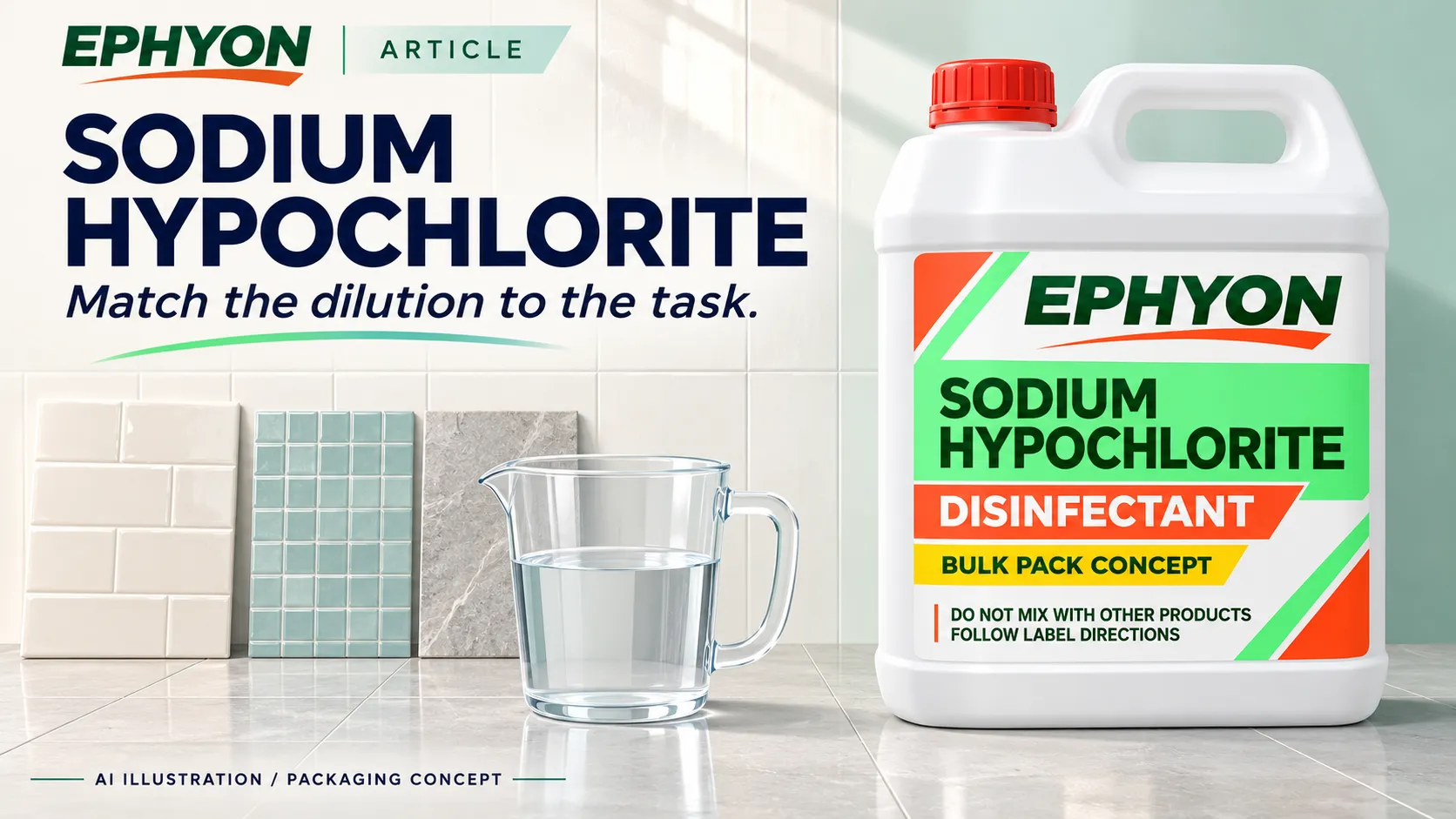
AI-generated packaging concept based on EPHYON’s listed handled-pack proposal. Capacity, available chlorine specification and packaging details remain subject to final confirmation.
When floors need disinfection, mold appears on tiles or white textiles need bleaching, many people think of sodium hypochlorite. It is an ingredient in common chlorine-based disinfecting and bleaching products and the main active ingredient in many products known in China as 84 disinfectant. The Chlorine Institute: Sodium Hypochlorite
The key is to match the task, material and working concentration. Floor disinfection and mold cleanup are different jobs. Even when preparing the same volume of working solution, different stock strengths require different amounts.
Why is sodium hypochlorite used for disinfection and bleaching?
Sodium hypochlorite has oxidizing properties and is used in corresponding disinfecting and bleaching products. Whether it suits an item and what treatment it supports must be established from the finished product directions, rather than its chemical name alone. The Chlorine Institute: Sodium Hypochlorite · China National Health Commission: Guidelines for the Use of Disinfectants (2020)
First identify the task: removing ordinary dirt, disinfecting a surface or cleaning mold. Not every household cleaning task requires disinfection. When a disinfectant is needed, choose the concentration and method specified by the product. US CDC: Cleaning and Disinfecting with Bleach
Floors and general surfaces: establish whether disinfection is needed
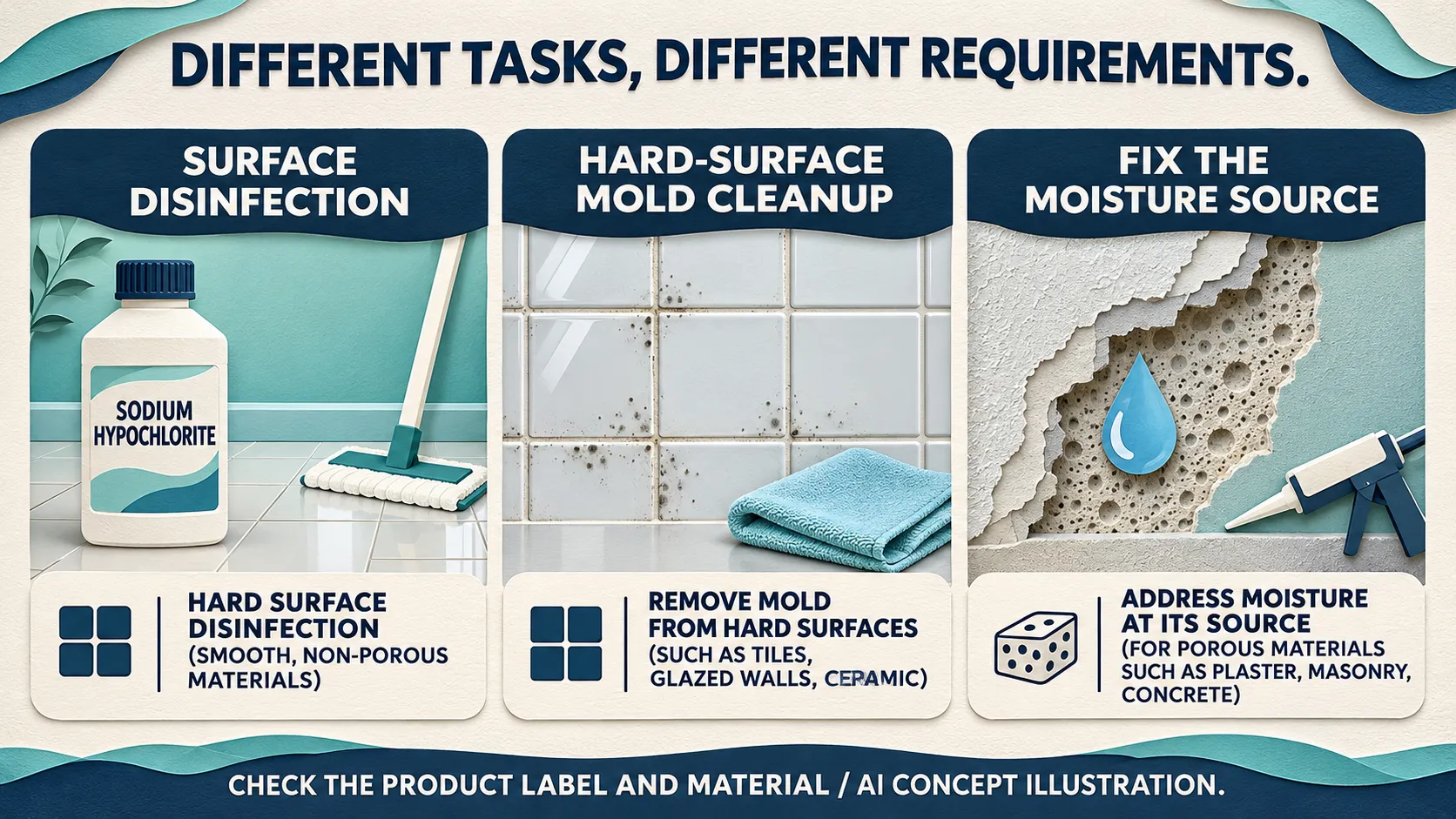
For compatible floors and hard surfaces covered by the product label, remove visible dirt before disinfecting. China’s National Health Commission’s 2020 Guidelines for the Use of Disinfectants give 500 mg/L available chlorine as a reference concentration for surface disinfection. This is the concentration of the working solution, not the stock liquid in the bottle. China National Health Commission: Guidelines for the Use of Disinfectants (2020)
This figure comes from a particular guideline and does not replace every product’s directions or establish suitability for every floor. Check compatibility, contact time and any required clean-water finishing step. Wood floors, metal trim and special coatings cannot simply be treated like tiles.
Mold on walls: identify the material first
Mold on smooth tiles requires a different approach from mold inside damp, porous wall materials. The US EPA advises cleaning mold from hard surfaces and drying thoroughly, while fixing leaks and other moisture problems. Moldy absorbent or porous materials may be difficult to clean completely and may need removal or replacement. US EPA: What Are the Basic Mold Cleanup Steps?
Do not try to solve mold in absorbent wall materials such as wallpaper or drywall simply by increasing the disinfectant concentration. Address damaged materials, moisture and hidden mold. A stain becoming lighter does not demonstrate that the wall’s mold problem has been resolved.
Is there a reference dilution for mold on hard surfaces?
Yes, but only with its stock-strength and use-context conditions. The US CDC’s post-disaster cleanup guidance specifies regular, unscented household bleach containing 5%–9% sodium hypochlorite. For mold on hard surfaces, it lists 240 mL bleach added to approximately 3.8 L water, followed by a clean-water rinse and drying. US CDC: How to Safely Clean and Sanitize with Bleach (Post-Disaster Guidance)
This is a conditional post-disaster reference, not a universal mold recipe for every wall. It must not be transferred directly to other strengths or formulations. Check that a mold-cleaning product’s label supports the intended material and use; a general floor-disinfection dilution is not automatically a mold-cleanup dilution.
Mold cleanup also calls for gloves, goggles, protection against inhaling mold particles and ventilation. An N95 protects against particles; it does not replace chemical-gas protection or ventilation. Extensive, recurring mold or serious water damage should be assessed by an experienced professional. US CDC: Mold Clean Up Guidelines and Recommendations · US EPA: A Brief Guide to Mold, Moisture and Your Home
Why do amounts differ when preparing the same 500 mg/L solution?
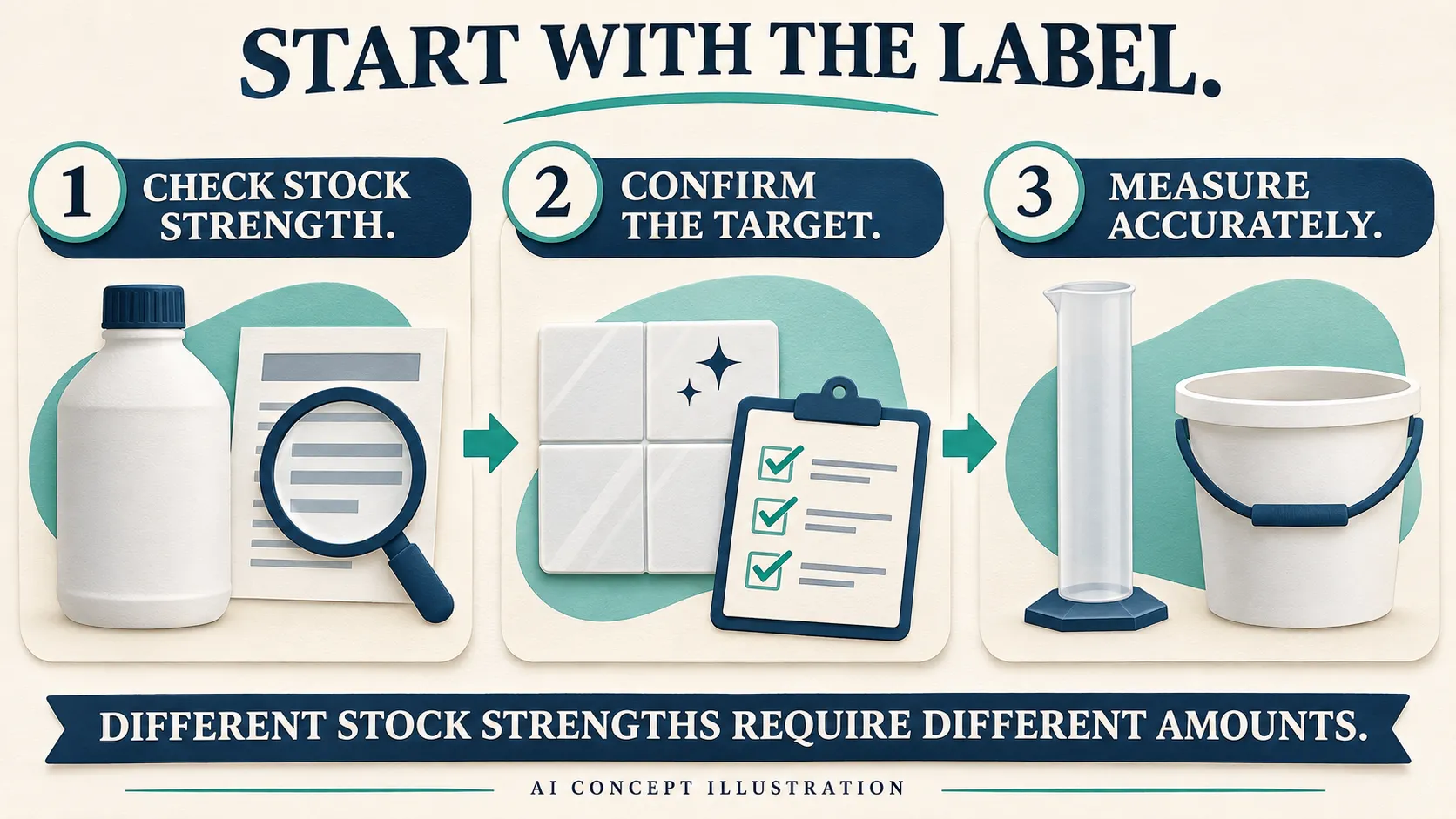
The following is a dilution calculation only. Assume the product label permits the intended use and specifies 500 mg/L available chlorine, with a final working volume of 1 L. Both stock strengths below refer to available chlorine; sodium hypochlorite content is not treated as the same indicator.
| Stock available chlorine | Target working solution | Stock volume | Water addition |
|---|---|---|---|
| 20 g/L (20,000 mg/L) | 500 mg/L; final 1 L | 25 mL | Prepare as labeled; add water to a total of 1 L |
| 50 g/L (50,000 mg/L) | 500 mg/L; final 1 L | 10 mL | Prepare as labeled; add water to a total of 1 L |
Calculation: stock volume = target concentration × final volume ÷ stock concentration, using consistent units. The approximate stock-to-water ratios are 1:39 and 1:99, respectively. Therefore, a universal 1:99 rule for all 84 bleach is incorrect. This table illustrates arithmetic, not the current specification or universal directions for an EPHYON product.
Check suitability before bleaching textiles or considering other uses
Chlorine-based products can bleach fabrics; colored textiles and some metals require caution. Even for white fabrics, check both the product directions and the care label. White color does not mean every fiber, trim and decoration tolerates chlorine bleach. China National Health Commission: Guidelines for the Use of Disinfectants (2020)
Likewise, drinking water, produce, food-contact surfaces and disinfection of the human body cannot use a general floor-treatment method. Such tasks require a finished product explicitly labeled for that use, rather than industrial sodium hypochlorite raw material or an ordinary floor-disinfection approach.
Turn the intended application into a product proposal
EPHYON’s website presents a Sodium Hypochlorite Disinfectant | Handled-Pack Proposal as a starting point for brands and channel buyers. The appearance is a packaging concept. Available chlorine specification, capacity, intended uses and label wording remain subject to project confirmation. EPHYON: Sodium Hypochlorite Disinfectant | Handled-Pack Proposal
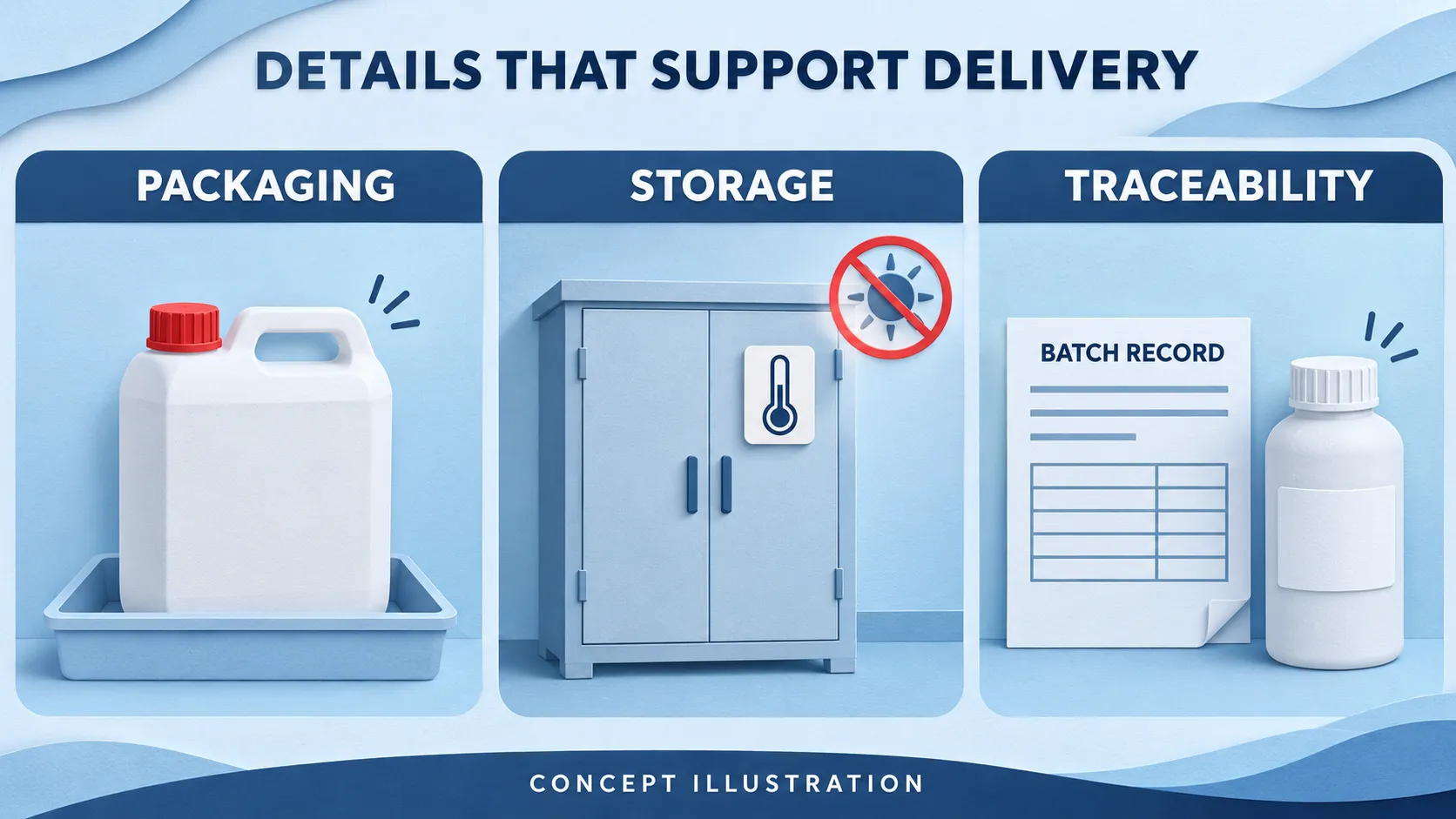
For floor disinfection, suitable hard-surface mold cleanup or textile bleaching needs, we first seek to understand the object, target market and packaging requirements before discussing a finished-product proposal and documentation. Public guidance referenced here does not mean the website proposal has been validated for all these uses.
Sodium hypochlorite’s value depends on an appropriate concentration, clearly defined use and correct method. Explaining those conditions helps a familiar ingredient serve a specific application appropriately.
References and original sources
The Chlorine Institute: Sodium Hypochlorite
China National Health Commission: Guidelines for the Use of Disinfectants (2020)
https://zwfw.nhc.gov.cn/kzx/tzgg/lyxclxgyhxhxwzscdsjyyswsaqcpdsp_261/202101/t20210118_2030.html
US CDC: Cleaning and Disinfecting with Bleach
https://www.cdc.gov/hygiene/about/cleaning-and-disinfecting-with-bleach.html
US EPA: What Are the Basic Mold Cleanup Steps?
US CDC: How to Safely Clean and Sanitize with Bleach (Post-Disaster Guidance)
https://www.cdc.gov/natural-disasters/safety/how-to-safely-clean-and-sanitize-with-bleach.html
US CDC: Mold Clean Up Guidelines and Recommendations
US EPA: A Brief Guide to Mold, Moisture and Your Home
https://www.epa.gov/mold/brief-guide-mold-moisture-and-your-home
EPHYON: Sodium Hypochlorite Disinfectant | Handled-Pack Proposal
https://www.ephyon.com/en/product/detail/sodium-hypochlorite-disinfectant-handled-pack/
Sources checked on 10 November 2026. Historical and overseas guidance retains its original context; it does not imply EPHYON registration, endorsement or validation for every use described.
Manufacturing Support · OEM / ODM
Need custom product development or manufacturing?
Our dual production bases provide ODM development and OEM manufacturing for household cleaning products, with solutions tailored to your formulation, packaging, and delivery requirements.