Rust Remover on Tile and Stone: Compatibility Checks Before OEM Sampling
A sourcing guide for rust-removal projects: identify tile, stone, finishes and grout, then assess cleaning results and surface condition separately.
On this page
Before choosing a rust remover for tile or stone, identify the exact material and finish. Removing a mark and preserving the surface are separate acceptance criteria. For a private-label project, request evidence for the proposed finished formulation rather than judging suitability from an acid name alone.
Procurement analysis dated November 12, 2026, based on existing care guidance; this is not an announcement of a new regulation or product launch.
Stone appearance does not establish acid compatibility
The Natural Stone Institute explains that acidic cleaners can dull or etch calcareous stone. It also warns that hydrofluoric acid can attack silicate minerals, including those in granite and quartzite. A broad description such as natural stone is therefore not a compatibility specification. [S1]
Ask for the stone identity, finish, coating or sealer information and the surface supplier’s care requirements. If the material is unknown or the care instructions exclude the proposed cleaner, pause selection. A trial is not a way to override an explicit exclusion.
Include tile finish and grout in the assessment
Daltile cautions against acid-based or solvent-based cleaning chemicals on fully polished impervious porcelain and polished-glaze porcelain, because these may damage the tile. Its care guidance also calls for suitability for the installation, including grout, and a small-area trial before wider use. These are surface-specific cautions, not a claim that every tile behaves alike. [S2]
As an editorial procurement recommendation, assess the complete assembly: tile face, finish, grout, sealer and nearby trim. Keep separate records for each proposed material. A result on an unglazed ceramic coupon does not validate a polished porcelain floor or marble surround.
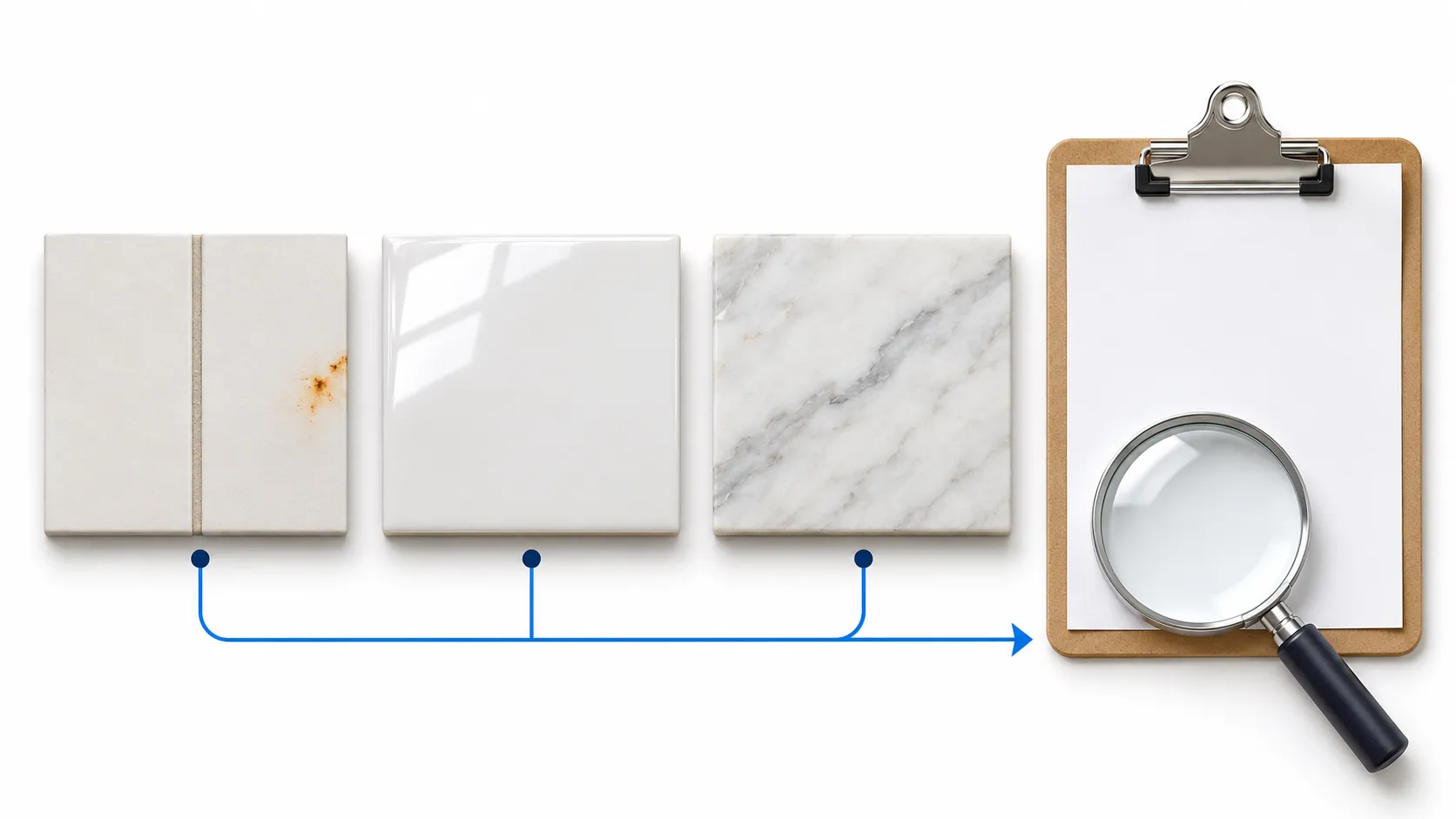
Record a useful compatibility trial
The following is an editorial sampling framework, not a validated test method or a substitute for the product label and surface manufacturer’s instructions. Agree the procedure and acceptance limits with the supplier before evaluating samples.
- Identify the sample material, finish and grout; keep an untreated comparison coupon where practical.
- Record the candidate formulation/version and batch. Use only the conditions permitted by both sets of instructions; do not invent dilution or contact times.
- Compare samples under the same agreed conditions. Record application, rinsing and drying so that proposals can be assessed consistently.
- After the permitted rinse and drying, document stain removal, colour, gloss, texture and visible grout changes under consistent lighting. Agree pass/fail limits in advance.
Persistent rust needs diagnosis, not automatic escalation
The Natural Stone Institute notes that deeply embedded rust can be difficult to remove and may leave permanent staining. Persistent discolouration alone does not establish that a stronger acid, longer contact or more abrasive action is appropriate. Seek specialist stone-care advice when the stain or material is uncertain. [S3]
Record unsuccessful cleaning and surface damage separately. A lighter stain with a dulled or roughened finish is not an acceptable result merely because a photograph looks cleaner.
Turn the findings into an OEM brief
Send the proposed supplier the target market, exact surfaces and finishes, intended use, product format, packaging and exclusions. Ask which statements are supported for the proposed formulation and which require further evaluation.
For a surface-cleaning project, review EPHYON’s Tile Cleaner listing and discuss the candidate product’s actual applications and limits. A catalogue entry does not prove compatibility with your stone or finished installation.
Discuss the Tile Cleaner specification
Sources and reference dates
- Natural Stone Institute — Care & Cleaning of Natural Stone. Accessed November 12, 2026; publication date not displayed.
- Daltile — Ceramic & Porcelain Tile Care Instructions. Accessed November 12, 2026; publication date not displayed.
- Natural Stone Institute — Stain Removal. Accessed November 12, 2026; publication date not displayed.
- EPHYON — Tile Cleaner. Accessed November 12, 2026; publication date not displayed.
Manufacturing Support · OEM / ODM
Need custom product development or manufacturing?
Our dual production bases provide ODM development and OEM manufacturing for household cleaning products, with solutions tailored to your formulation, packaging, and delivery requirements.